

Why Surface Crack Testing Matters
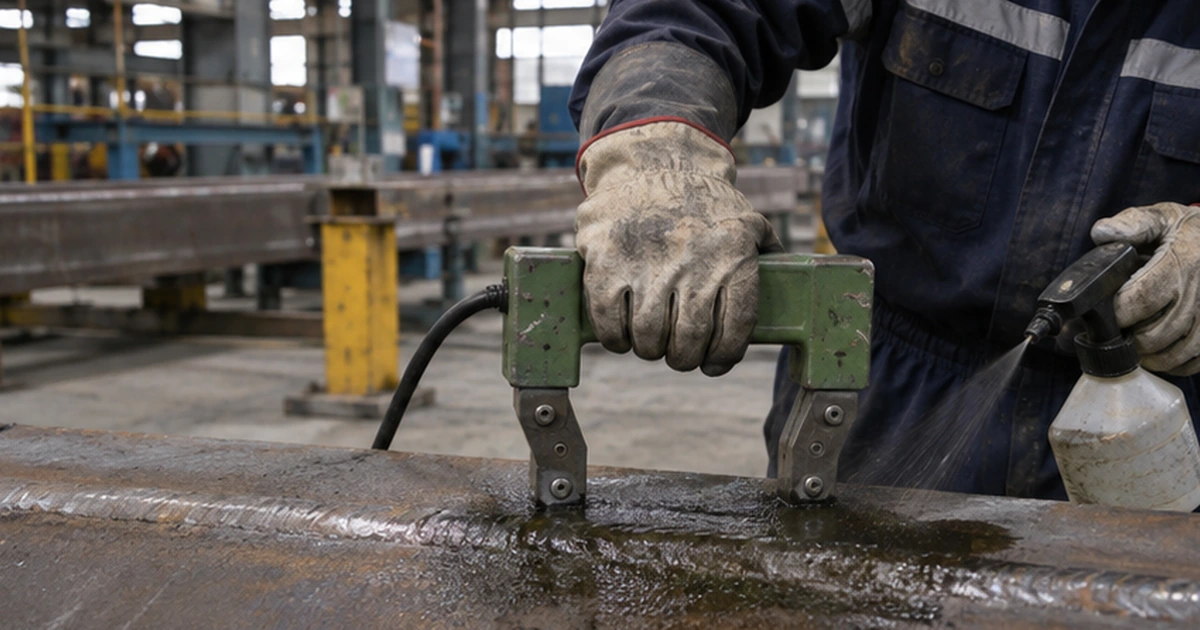
Many weld failures start at the surface: toe cracks, crater cracks and fatigue cracks. These can be too fine to see by eye. Surface crack testing reveals them quickly and cheaply, using either magnetic particle testing (MT) or dye penetrant testing (PT). Both are standard on structural welds, pressure equipment, lifting gear and repairs.
Magnetic Particle Testing (MT)
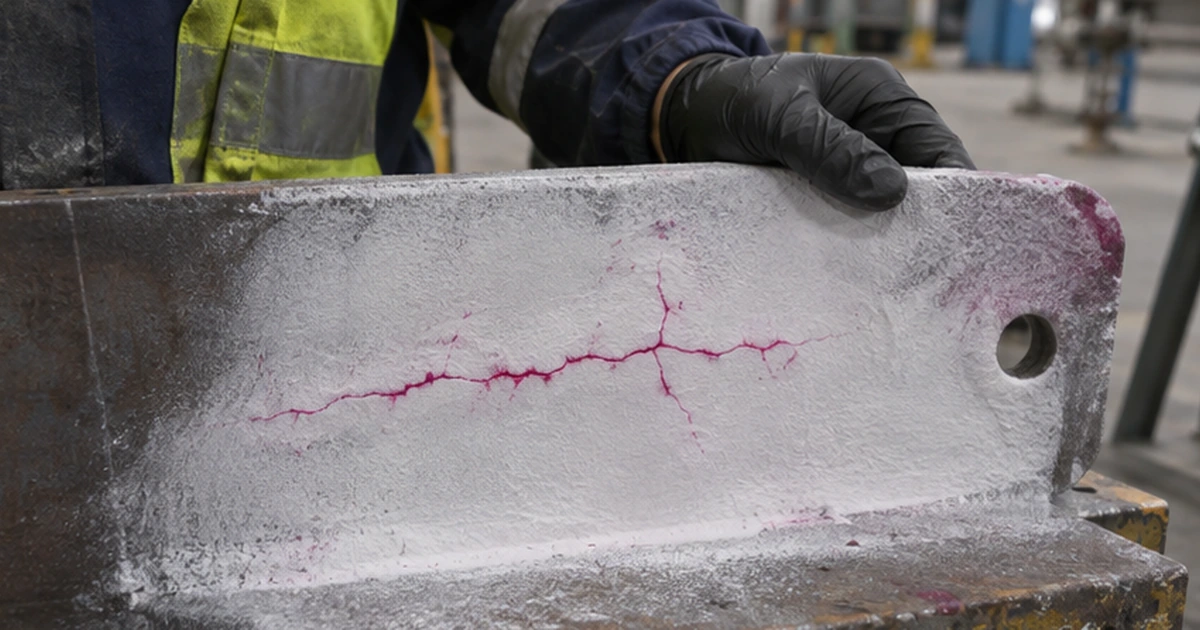
MT works only on ferromagnetic materials such as carbon and low-alloy steels. A magnetic field is applied to the part, usually with an electromagnetic yoke. Where a crack interrupts the field, magnetic flux leaks out at the surface. Fine iron particles, applied as a powder or in a liquid, gather at the leakage and outline the crack.
- Black ink on white contrast paint: common on site, viewed in normal light
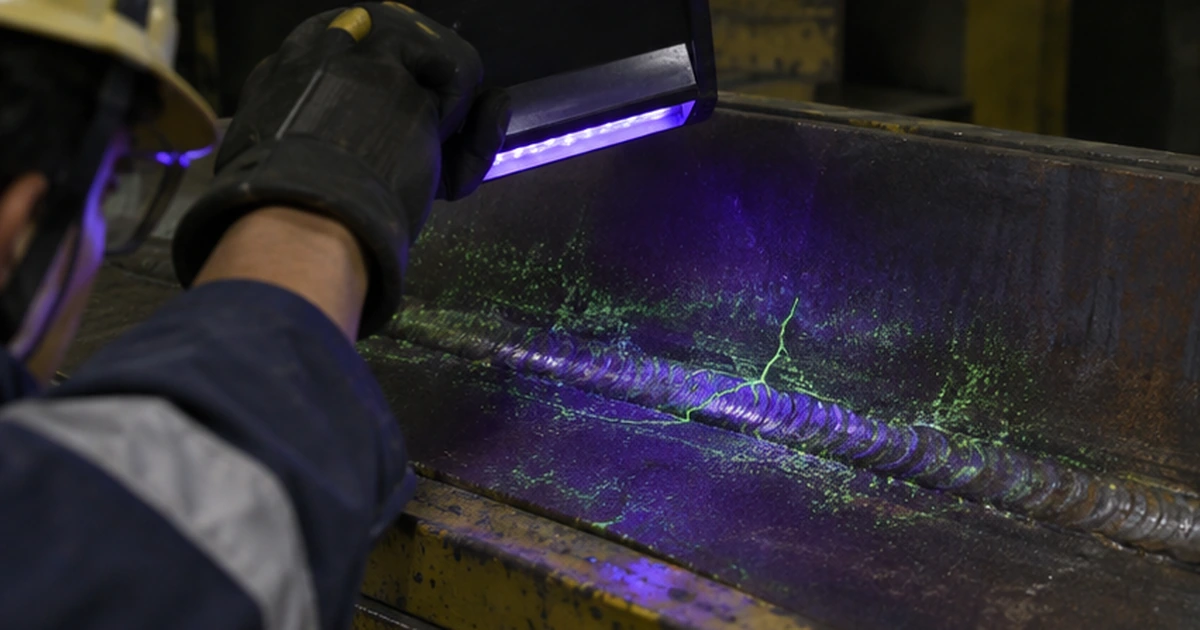
- Fluorescent particles: viewed under UV light in darkened conditions, more sensitive
- Detects surface and slightly subsurface cracks
- The field must be applied in two directions, as cracks parallel to the field are not shown
Dye Penetrant Testing (PT)
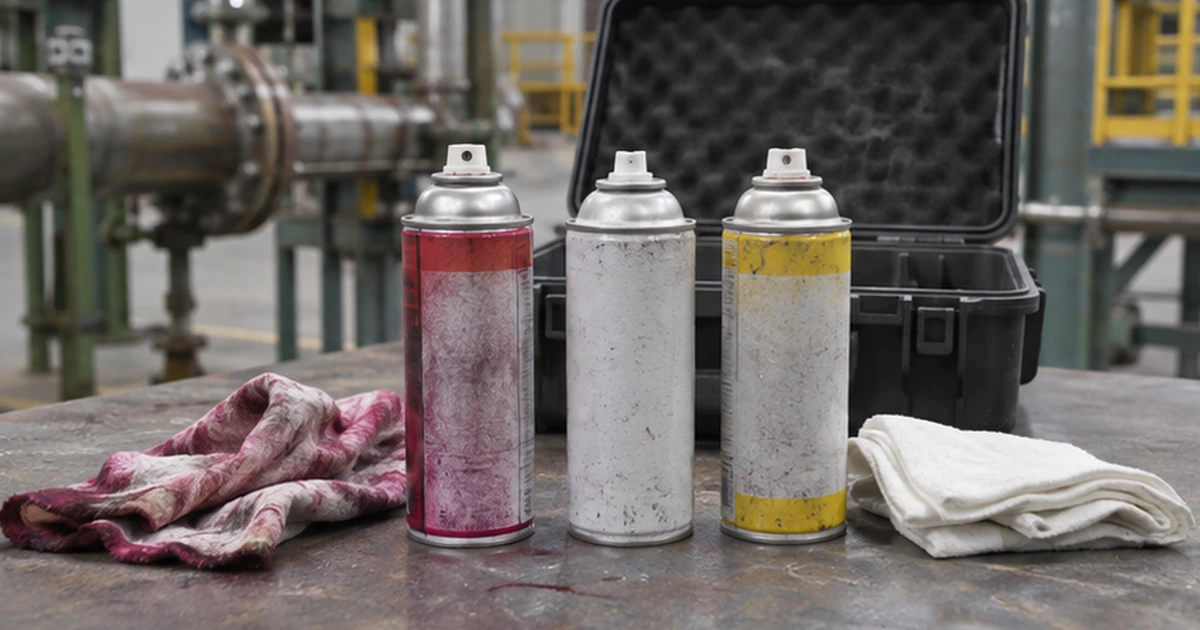
PT works on any non-porous material, including stainless steel, aluminium, copper alloys and nickel alloys, where MT cannot be used. The method has four basic steps:
- Clean the surface thoroughly and let it dry
- Apply penetrant and leave it for the specified dwell time, often 10 to 30 minutes
- Remove excess penetrant from the surface without washing it out of the defects
- Apply a thin developer, which draws the penetrant out and shows cracks as red lines on white
PT detects only defects open to the surface. Anything sealed below a smear of metal or paint stays hidden, so grinding and cleaning before testing must be done carefully.
Choosing Between MT and PT
For carbon steel, MT is usually faster, more sensitive and less affected by surface condition. For non-magnetic materials, PT is the choice. Both depend on good surface preparation, correct procedure and qualified operators, and results are assessed against standards such as ISO 23278 for MT and ISO 23277 for PT.
From My Experience
On repair work, I check the excavation by MT or PT before welding, not only after. If a crack has not been fully removed, welding over it simply buries it. A quick penetrant check at the bottom of the groove saves a failed repair.
Conclusion
Surface crack testing with MT or PT is fast, inexpensive and finds the cracks that start most failures. Use MT on steel and PT on everything else. See also visual weld inspection and ultrasonic testing of welds.
If you found this article useful, feel free to share it with colleagues who work with inspection and maintenance teams. — Zisis
Need Help on a Project?
For welding supervision and quality control on marine and industrial work, see Welding Supervision or request a quote.