

What Is Submerged Arc Welding
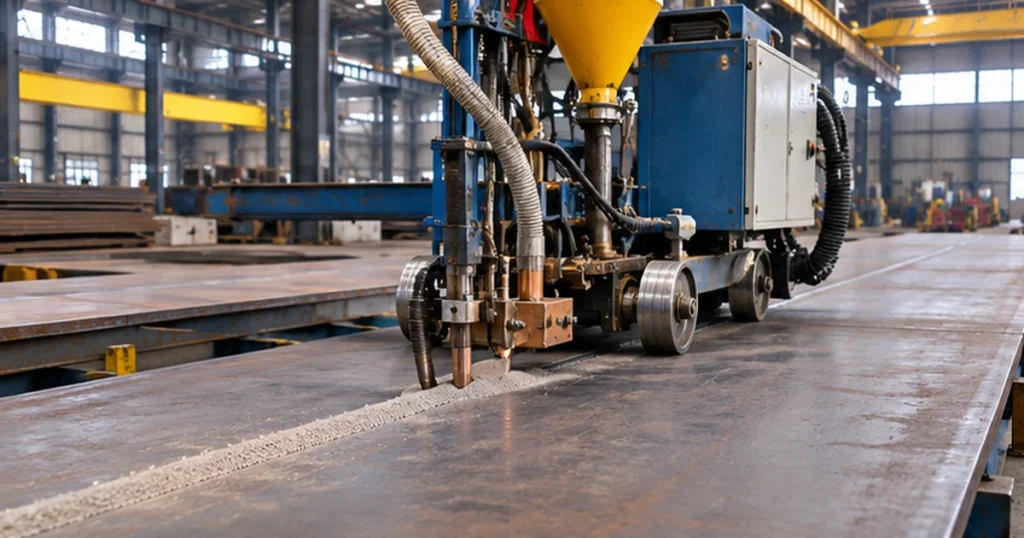
In submerged arc welding (SAW), an arc forms between a continuously fed wire and the workpiece, under a blanket of granular flux. The flux produces a gas shield and a slag that protect the weld, so no shielding gas is needed and the arc is not visible. TWI covers the process in detail in its guide to submerged arc welding.
A Short History
The first patent on submerged arc welding was taken out in 1935 and covered an arc beneath a bed of granulated flux. The process was developed further at the E. O. Paton Electric Welding Institute in Kiev during the Second World War, where its best-known use was in tank production.
Process Variants
- Single wire: the standard set-up for most plate and pipe work
- Twin wire: two wires through one contact tip for higher deposition
- Tandem: two or more separate arcs in line for very high travel speeds on thick plate
- Strip cladding: a wide strip electrode used to overlay corrosion-resistant layers on vessels
Where SAW Is Used
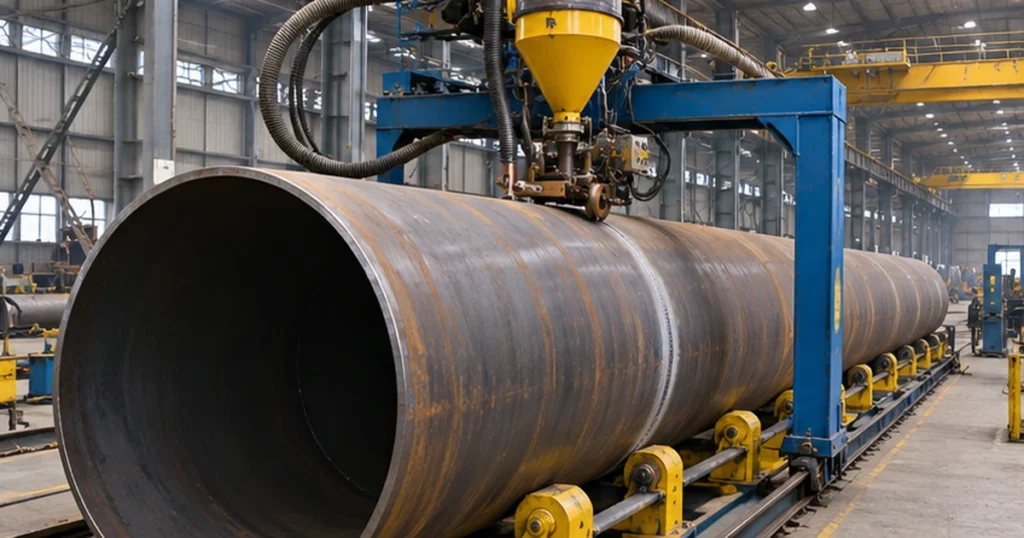
- Longitudinal and spiral seams in pipe mills
- Pressure vessels and storage tanks
- Heavy structural steel and beams
- Shipyard panels and offshore structures
Because the flux must stay in place, SAW is used in the flat position and for horizontal fillets. Round parts are rotated under the head.
Wire diameters are usually 2.0 to 6.0 mm, and twin-wire or tandem set-ups are used to raise output further on thick plate.
Joint Preparation for SAW
Because SAW penetrates deeply, joints are often prepared with a smaller bevel or a larger root face than for manual welding, and thick plate can be welded from both sides with few passes. The root must be supported, either by a backing strip, a flux backing or a manual root pass made first. Fit-up has to be consistent along the whole seam, since the operator cannot adjust for gaps the way a manual welder can.
On heavy fabrication this preparation pays back quickly: fewer passes, less distortion and very consistent weld quality from one seam to the next.
Quality Control
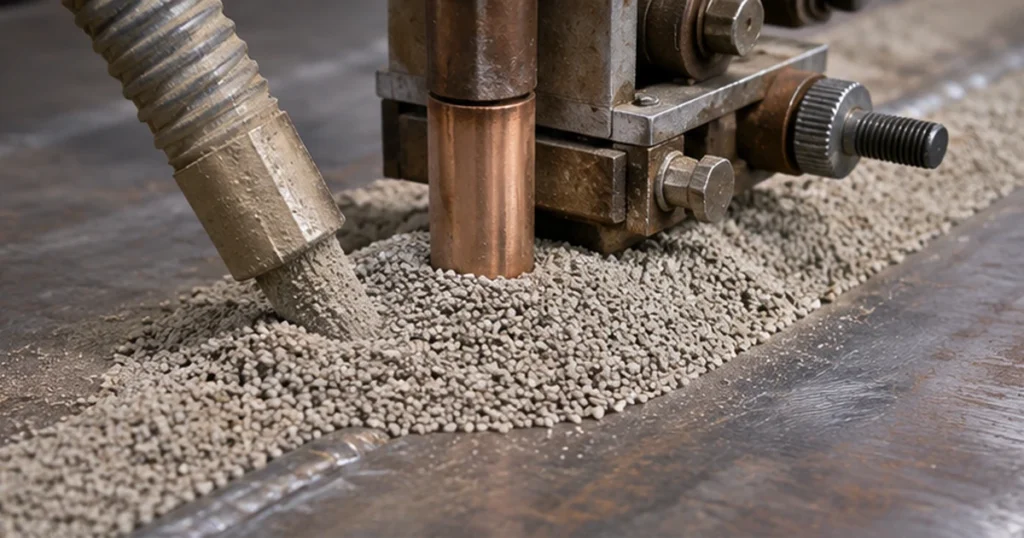
Quality depends on the wire and flux combination and on current, voltage, travel speed and wire feed. Flux must be kept dry: damp flux causes porosity and can add hydrogen to the weld. Unused flux can be recovered and reused if it stays clean and dry.
Flux type matters too: fused fluxes are less sensitive to moisture, while agglomerated fluxes allow alloying additions and better toughness but need drier storage.
Fume and Working Conditions
Because the arc is covered, SAW gives negligible fume and no visible arc radiation, which makes working conditions better than most open-arc processes. With highly basic fluxes, exposure to fluorides should still be considered, and hot slag and flux dust need normal care.
Advantages and Limits
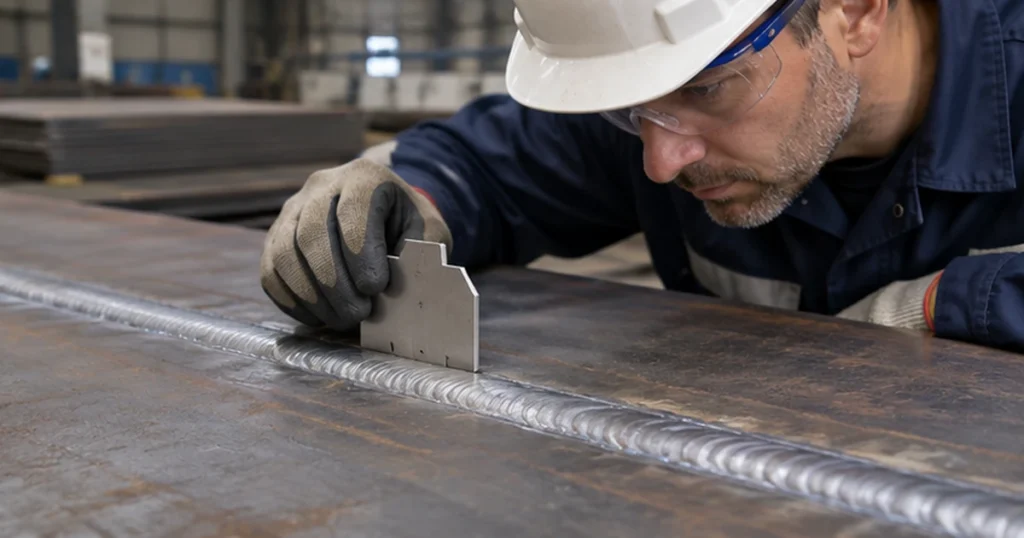
SAW gives high deposition rates, deep penetration, consistent welds, no arc flash and very little fume. Its limits are the flat position, the need for mechanised equipment and good fit-up, and no view of the weld pool. Like any process, it needs an approved welding procedure specification.
Conclusion
Submerged arc welding is the process of choice for long, heavy seams where productivity and consistency matter more than flexibility.
Need Help on a Project?
For specialized welding on demanding materials on marine and industrial work, see Specialized Welding or request a quote.